Showing posts with label parents and social media. Show all posts

How Parent's Social Media Addiction Affects Their Children

Let's be honest.  Kids and students aren't the only ones addicted to social media.  Parents are as well.  Take a look around and you'll see parents often focused on their cell phone...even when their kids need their attention.  Parents can become so absorbed with their devices, that it is difficult for their children to get their attention.

How does this affect children?  Studies show that parents who are constantly checking their phones for texts, email and social media updates are more likely to have kids who misbehave than people who are able to step away from their screens.  Yes, parent's social media addictions can influence their child's behavior in a negative way and cause parenting problems.  Kids need their parent's attention and will misbehave to get it if needed.  Many times, the temper tantrums, whining or hyperactivity is a child trying to get their parent to look at them rather than their cell phone.  

As we parent our own children and as we speak into the lives of the parents in our ministries, here are some steps we can encourage.

Set aside phones and tablets during meal time.  In a survey, 48% of parents reported technology interruptions at least 3 times a day.  You can avoid this happening during meal time by being intentional about turning off or silencing devices.  Meal time is a key time when parents have the opportunity to connect with their kids and engage in conversation. 
 
Carve out some "no social media" times that you spend focused entirely on your kids each day.  Professor Larry Rosen from the California State University says, "Parents worried about how technology disrupts their family time can try to carve out periods of each day when the devices go away and they focus only on their kids.  Children crave a connection to their parents and learn from their parents’ behaviors.  Constantly checking your phone is going to have a negative impact on this connection.”

Focus more on your kids than you do on pictures of your kids on social media.  If we are not intentional, we will spend more time looking at the pictures of our kids that we've posted on social media than we do actually looking at our kids in person.  Let's be honest.  As parents, we feel the pressure to post pictures of our kids and then carefully watch how many "likes" the pictures bring.  But don't let chasing likes cause your kids to grow up and not like you because it caused you to not focus on them.

Take a vacation from social media on your vacation.  Yes, take pictures, but don't get so absorbed with posting them that you don't maximize the time with your children and miss the magic of the moments.

Social media addiction is real and can have a grip on all of us.  Just try sitting aside your phone for a day and you will feel the pull.  We must make the pull toward meaningful connections with our kids be greater than the pull toward social media.

Best Online Ways to Get Your Message to Families


If you're going to effectively communicate with families, you've got to include social media as a major part of your strategy.

Recent studies by Pew Research Center reveal how much families use social media to find information and interact with others.

A majority of families say they now get their news through social media.  In the recent presidential election, over half of families turned to social media to learn about the election.  Parents are using social media throughout the day, even at work.

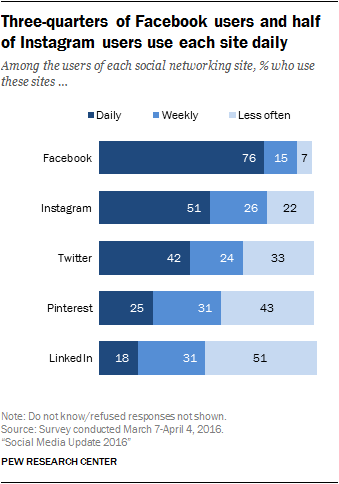
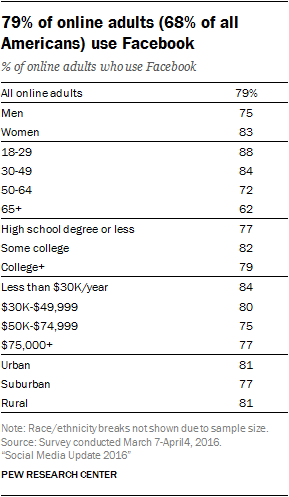
Facebook continues to be the most popular social networking platform.  79% of Americans use Facebook.  This means that 68% of all adults are Facebook users.  It has increased by 7% points in the last year.  76% of Americans who use Facebook say they check it daily.  This is up from 70% who checked it daily in 2015.

Millennials continue to use Facebook at high rates and older adults are joining in increasing numbers.  62% of adults ages 65 and older now use Facebook.  This is up from 48% in 2015.  Here's a visual look at the stats.


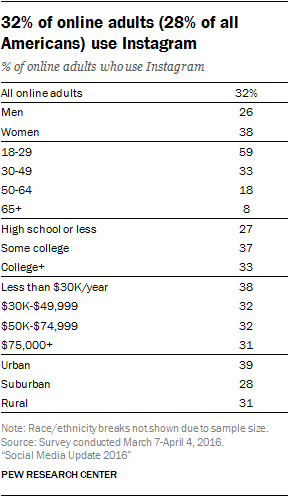
Instagram.  32% of internet users are on Instagram.  This is up from 27% in 2015.  It is especially popular among younger adults.  59% of them use Instagram.  This is double the share among 30 to 49-year-olds who are at 33%.  Only 8% of those ages 65 and older use Instagram.  Females use Instagram (38%) more than men (26%). 


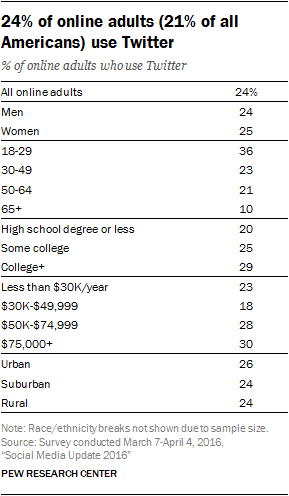
Twitter.  24% of internet users are on Twitter.  36% of adults ages 18-29 are on Twitter.  This is more than triple the percentage of adults ages 65 and older who are on Twitter.


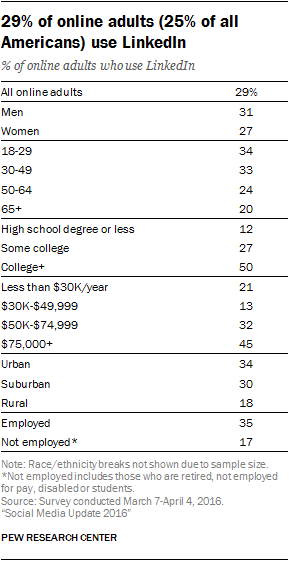
LinkedIn.  29% of internet users are on LinkedIn.  This has remained steady over the past year.  LinkedIn is especially poplar among college graduates and high income earners.  50% of adults with college degrees are on LinkedIn.


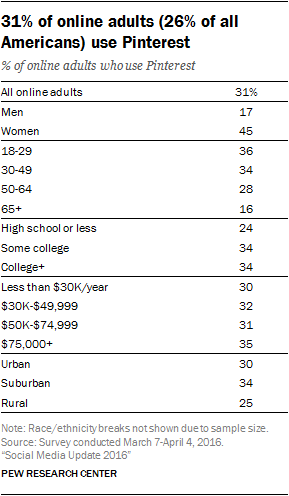
Pinterest.  31% are on Pinterest.  This has remained unchanged from 2015.  Women use Pinterest much more than men.  45% compared to 17%.  


This chart shows how often families are using social media sites each day.


Messaging apps via Smartphones.  72% of Americans own a smartphone.  
  • 29% of smartphone owners use general-purpose messaging apps such as WhatsApp or Kik.
  • 24% use messaging apps that automatically delete sent messages, such as Snapchat or Wickr.
  • 5% use apps that allow people to anonymously chat or post comments, such as YikYak or Whisper.
  • 56% of smartphone owners ages 18 to 29 use auto-delete apps, more than four times the share among those 30-49 (13%) and six times the share among those 50 or older (9%). 
  • 42% of smartphone owners ages 18 to 29 use more general messaging apps like WhatsApp or Kik, compared with 19% of smartphone owners ages 50 or older.
Formulating your social media communication strategy.  I would encourage you to sit down as a team and if you haven't done so, to formulate a strategy for using social media to communicate with families.  If you want to effectively communicate with them, you've got to go where they are.  In 2017 that means social media must be one of your primary platforms.

Here's some ideas for using social media to communicate with families.
 
Here's some ideas for using Facebook to communicate with families.

Here's some ideas for using text messaging to communicate with families.

Your turn.  The floor is yours.  How do you use social media to communicate with families?  Share your thoughts and ideas in the comment section below.